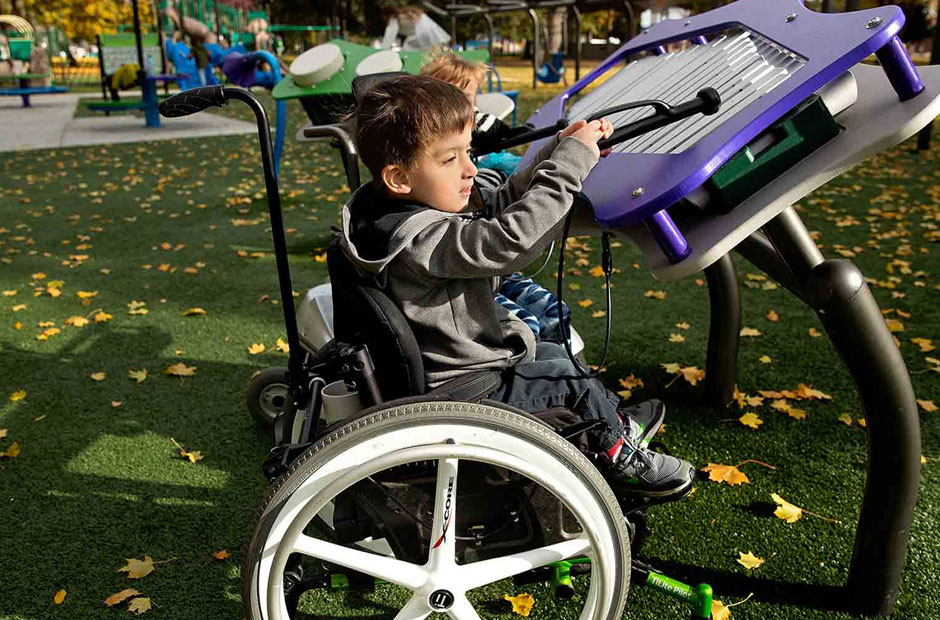
Play is not just a pastime; it is the work of childhood. Through play, children develop physical strength, social skills, and emotional resilience. It is how they learn to navigate the world and their relationships with others. Yet, for millions of children with mobility impairments, the local playground is often a place of barriers rather than opportunities.
Understanding Mobility Impairments in the Context of Play
To design an effective playground, one must first understand the users. Mobility impairments vary widely. Some children use power wheelchairs or manual wheelchairs, while others rely on walkers, crutches, or braces. Some may have gait differences or reduced muscle tone that makes balancing on uneven surfaces difficult.
For a child using a mobility device, the primary challenge is often the ground itself. Loose-fill surfaces like sand, gravel, or wood chips create immediate obstacles. Wheels sink into these materials, making movement exhausting or impossible. Even for a child who can walk but has balance issues, these shifting surfaces present a tripping hazard that can incite fear rather than fun. Consult with Home accessibility assessment services today!
Beyond the surface, there is the issue of reach and engagement. A playground where all the interactive elements are located on elevated platforms accessible only by ladders effectively segregates children. If the only accessible route is a ramp that leads to a dead end, the child is still isolated. The goal is to facilitate “social integration”—ensuring that a child with a disability can be in the middle of the action, right alongside their friends.
Core Design Principles for Accessibility
Creating a truly inclusive space involves adhering to universal design principles. These guidelines ensure that the environment is usable by people with the widest possible range of abilities.
Seamless Surfacing
The foundation of an inclusive playground is its surfacing. As mentioned, loose-fill materials are often barriers. Poured-in-place rubber (PIP) or bonded rubber mulch are superior alternatives. These surfaces provide a firm, stable footing for wheelchairs and walkers while still offering the necessary impact attenuation to prevent injuries from falls. Synthetic turf is another excellent option, offering a natural look while maintaining accessibility. These surfaces allow children to move independently without expending unnecessary energy fighting the terrain.
Wide and Continuous Pathways
Getting onto the playground is only the first step; navigating it is the next. Pathways should be wide enough to accommodate two wheelchairs side-by-side, allowing friends to move together or pass one another comfortably. The layout should be continuous. Circuit loops are fantastic for children who love to run or wheel around, as they provide a sense of endless motion without the frustration of hitting a dead end and having to turn around in a tight space.
Ramps and Transfer Systems
If equipment is elevated, there must be a way to get there. Ramps are essential, but they must be integrated thoughtfully. A ramp should lead to meaningful play experiences, not just an empty platform. Along the way, interactive panels or sensory walls can keep the journey engaging.
For equipment where a wheelchair cannot go (like a traditional slide), transfer systems are vital. These are series of platforms at varying heights that allow a child to lift themselves out of their chair and scoot up to the slide or climber. Handrails and grab bars must be positioned strategically to support this movement, giving the child autonomy.
Climate Control and Comfort
Physical exertion can be more taxing for children with certain mobility impairments. Additionally, some medications or conditions can make children more sensitive to heat and sun exposure. Providing respite is a safety issue as much as a comfort one. Designers must incorporate shaded areas over high-activity zones and rest benches. For example, adequate sun protection is vital in hot climates—think about how necessary proper park shade in Utah is during July. Without these considerations, a playground might be technically accessible but practically unusable during peak daylight hours.
Selecting the Right Equipment
The equipment chosen for the playground defines the activities that can take place. Fortunately, playground manufacturers are increasingly innovative in creating gear that supports mobility impairments.
Adaptive Swings and Rockers
Swinging is a playground staple that provides crucial vestibular input. Traditional belt swings require strong core stability, which not all children possess. Adaptive swings with high backs and harnesses provide the necessary support for children with low muscle tone to swing safely.
However, a truly inclusive playground goes a step further with the “Liberty Swing” or wheelchair platform swings, which allow a child to roll onto the swing and lock their chair in place. This eliminates the need to transfer out of the chair, which can be difficult or undignified for older children.
Accessible Slides
Slides are often the main attraction. Roller slides are a fantastic option for children with mobility issues. The rollers reduce friction, eliminating the static shock that can damage cochlear implants and making it easier for children with limited lower-body strength to slide down without getting stuck.
Embankment slides—slides built into a hill—are another clever design choice. Because the slide rests on the ground, a child can transfer onto it at the top and be met at the bottom with a mobility device, or even crawl back up via a transfer system or gentle slope. It integrates the landscape with the equipment.
Ground-Level Play
Not every thrill needs to happen six feet in the air. Ground-level play components ensure that children who cannot or prefer not to climb still have a wealth of options.
- Sensory Panels: Walls featuring gears, bells, drums, and tactile puzzles allow children to engage cognitively and socially.
- Accessible Merry-Go-Rounds: These are flush with the ground, allowing wheelchairs to roll directly onto them. They often include seats for those who need them and standing space for others, fostering cooperative play where everyone spins together.
- Imaginative Spaces: Playhouses, storefronts, and train structures at ground level encourage role-playing games that don’t require climbing.
Conclusion
The impact of an inclusive playground extends far beyond the property lines of the park. When a community invests in a space where children with mobility impairments can play freely, they are making a statement about value and belonging.