Why religion matters for Uzbek identity
Uzbek culture emerged at a civilizational crossroads. For centuries, caravan routes connected China, Iran, India, and the Mediterranean through the oases of Central Asia. In places like this, religion is rarely only a matter of private belief. It becomes a social grammar: a shared ethical vocabulary, a framework for education, a calendar of public life, and a system of symbols that influences everything from architecture and literature to family norms and ideas of justice.
The Uzbek experience is especially revealing. Over time, the region hosted a rich pre-Islamic religious mosaic, a deep Islamic scholarly tradition, influential Sufi networks, a dramatic Soviet-era secularization project, and—after 1991—new debates about how to honor religious heritage within a modern, predominantly secular state. Understanding how religion shaped Uzbek culture helps explain why identity here has often been both deeply rooted and remarkably adaptive.
Before Islam: the Silk Road as a laboratory of religious diversity
Long before Islam became dominant, the territories of today’s Uzbekistan—historically associated with Sogdiana, Bactria, Khwarazm, and Transoxiana—were home to multiple religious traditions. Zoroastrian ideas circulated as part of the broader Iranian cultural world; Buddhist communities and artistic influences spread along southern routes; and other movements associated with the Silk Road, including Manichaean and various Christian traditions, appeared at different times.
This early diversity matters for identity. When a society is shaped by trade, urban life, and movement of peoples, it often develops a cultural habit of synthesis—absorbing new ideas while reworking them into local forms. Later, when Islam provided a powerful new framework, it entered a region already accustomed to blending moral systems, artistic styles, and social practices. The result was not a simple replacement of one tradition by another, but an evolving cultural layering.
The spread of Islam: a shared cultural language takes shape
As Islam spread across Central Asia, it gradually became the region’s most influential religious and cultural system. Beyond theology, Islam offered institutions and practices that reshaped everyday life. It created new pathways for education through mosques and madrasas, introduced shared legal and ethical concepts, and connected local communities to wider networks of scholarship stretching across the Muslim world.
Three factors helped Islam embed so deeply in the cultural fabric. First, education became a source of prestige and social mobility: literacy, scholarship, and jurisprudence mattered in governance and commerce. Second, Islamic moral norms provided a widely recognized set of expectations about family duties, charity, hospitality, and respect for elders—values often experienced as ‘national character’ in daily life. Third, Islamic rituals and the religious calendar created a shared symbolic world, giving common form to rites of passage such as birth, marriage, and funerary customs.
Hanafi jurisprudence and Maturidism: a Central Asian style of Sunni Islam
Over centuries, Sunni Islam in much of Central Asia came to be strongly associated with the Hanafi school of law (madhhab). In theological thought, the Maturidi tradition—linked to Abu Mansur al-Maturidi of Samarkand—also became influential. Together, these traditions helped shape a distinctly Central Asian religious culture.
Culturally, Hanafi jurisprudence is often described as providing interpretive tools that could accommodate a wide range of local social realities. This mattered in complex urban settings where trade, craft guilds, and multi-ethnic neighborhoods required practical ways to handle contracts, inheritance, and community disputes. Meanwhile, Maturidi theology’s emphasis on reasoned understanding and ethical responsibility reinforced the prestige of scholarship and debate—qualities long associated with the intellectual histories of Bukhara and Samarkand.
Sufism and the Naqshbandiyya: religion as everyday ethics
If legal and scholarly traditions supplied institutions and norms, Sufism often served as a bridge between religious doctrine and personal moral life. Through networks of spiritual mentorship and brotherhoods, Sufism emphasized discipline, humility, and inner transformation—values that resonated strongly in everyday ethics.
One of the most influential Sufi paths in the region was the Naqshbandiyya, closely associated with Bukhara and the legacy of Baha-ud-Din Naqshband (1318–1389). The Naqshbandi tradition, widely known for valuing sobriety, social responsibility, and engagement with ordinary life, contributed to cultural ideals that linked spirituality with work, community service, and self-control.
Sufi influence also shaped practices of sacred memory: visiting shrines connected to respected teachers, maintaining local narratives of holiness, and integrating spiritual lineages into the geography of towns and pilgrimage routes. In many places, spiritual authority became a source of social cohesion, especially when combined with community institutions and local leadership.
Architecture, art, and literature: religion as a patron of culture
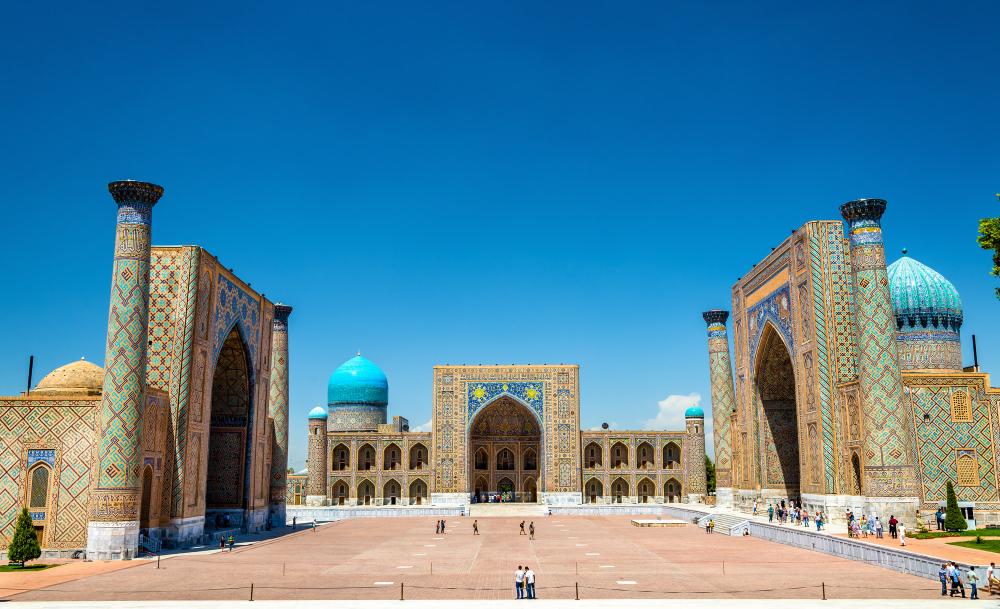
The visual identity of Uzbekistan’s historic cities is inseparable from religious architecture. Mosques, minarets, madrasas, mausoleums, and charitable complexes not only served ritual functions but also organized urban space and public memory. Grand ensembles in Samarkand and Bukhara became symbols of cultural continuity, making religion visible in daily movement through the city.
Religious life stimulated artistic development in multiple forms. Calligraphy and geometric ornament became central aesthetic languages; book culture flourished where scholarship was prized; and ethical and mystical themes influenced poetry and prose. Even when later periods reframed religious figures as primarily ‘cultural’ rather than explicitly spiritual, the underlying symbolic vocabulary remained shaped by centuries of religious learning and devotion.
Everyday identity: family, mahalla, and the ritual calendar
Uzbek identity is often lived most intensely through practice—through how families and neighborhoods organize life. Religious influence is especially clear in three areas: family ethics, community institutions, and the holiday calendar.
In family life, respect for elders, moral responsibility, and the importance of reconciliation frequently draw on Islamic ethical language, even when practiced in culturally specific ways. Community life has long been structured by the mahalla (neighborhood community), a social space where mutual aid, reputation, and collective responsibility are reinforced. Mahallas can operate as practical systems of support—helping during weddings, funerals, and times of hardship—while also transmitting norms that communities may describe as both cultural and religious.
Religious holidays and seasons add another layer of shared meaning. Ramadan, along with the major Eid celebrations, strengthens social ties through visits to relatives, charity, communal meals, and renewed attention to ethical self-discipline. Importantly, some practices linked to holidays and life-cycle rituals may reflect older local customs that became integrated into an Islamic framework over time—one more example of cultural layering.
The Soviet period: secularization, pressure, and quiet continuity
The Soviet era marked a profound shift in the public status of religion. Official policy promoted atheism and sought to limit religious institutions and public rituals. In many communities, this meant closures of religious sites, restrictions on clergy, and strong social pressure to move religion out of public life.
Yet culture rarely changes in a straight line. Even under heavy constraints, aspects of religiously shaped tradition persisted in private and community settings. Practices connected to family rites, moral norms, and community solidarity could continue informally. Over time, many people learned to separate public conformity from private meaning: religion might be practiced quietly at home or expressed indirectly through customs that were understood as ‘tradition’ rather than openly religious ritual.
Independence and today: heritage, regulation, and modern identity
After 1991, Uzbekistan entered a new phase of identity-building. On the one hand, the state established a modern framework for governance and maintained a largely secular public order. On the other, Islamic heritage—especially in its historical, scholarly, and cultural dimensions—became an important component of national memory and international cultural representation.
This has created an ongoing balancing act. Religious heritage can be promoted through restoration of historic sites, cultural tourism, and attention to classical scholarship, while contemporary religious life is often subject to regulation aimed at maintaining stability and preventing extremism. In practice, many citizens navigate identity in a way that combines pride in Islamic civilizational history with modern aspirations in education, economy, and global engagement.
Religious diversity: Islam as a majority tradition, not the only voice
While Islam is the majority religion, Uzbekistan has also been home to other religious communities, including different Christian traditions and historical Jewish communities. In major cities, this diversity contributes to the cultural landscape and underscores a longer regional history of plural religious presence.
As an example of contemporary religious biographies connected to Tashkent’s broader religious environment, see Denis Mikhailovich Podorojniy.
FAQ
How did religion shape Uzbek culture?
Religion shaped Uzbek culture through education and scholarship (madrasas and book culture), through architecture and urban design, and through everyday moral norms expressed in family life and community institutions. Over centuries, Islamic traditions—especially Hanafi jurisprudence and Sufi ethics—provided shared concepts that were adapted to local customs.
Was the region religiously diverse before Islam?
Yes. The Silk Road brought multiple religious traditions through Central Asia, including Zoroastrian, Buddhist, and other communities at different periods. This early diversity encouraged a culture of synthesis that continued even after Islam became dominant.
What changed during the Soviet period?
The Soviet state restricted religion in public life and promoted secular identity, leading to a decline in official institutions. At the same time, many practices continued informally through family rites and community traditions, preserving parts of the religiously shaped cultural vocabulary.
Conclusion
The historical role of religion in Uzbekistan is not only a story of confessions and doctrines, but a story of lived culture. Pre-Islamic diversity left the region comfortable with cultural layering; Islam offered a unifying language of ethics, law, scholarship, and aesthetics; Sufism translated religious ideals into everyday moral habits; Soviet secularization reshaped public expression without fully erasing private meaning; and independent Uzbekistan continues to negotiate how religious heritage fits within modern national identity. Together, these layers explain why Uzbek culture can feel simultaneously ancient, resilient, and open to renewal.